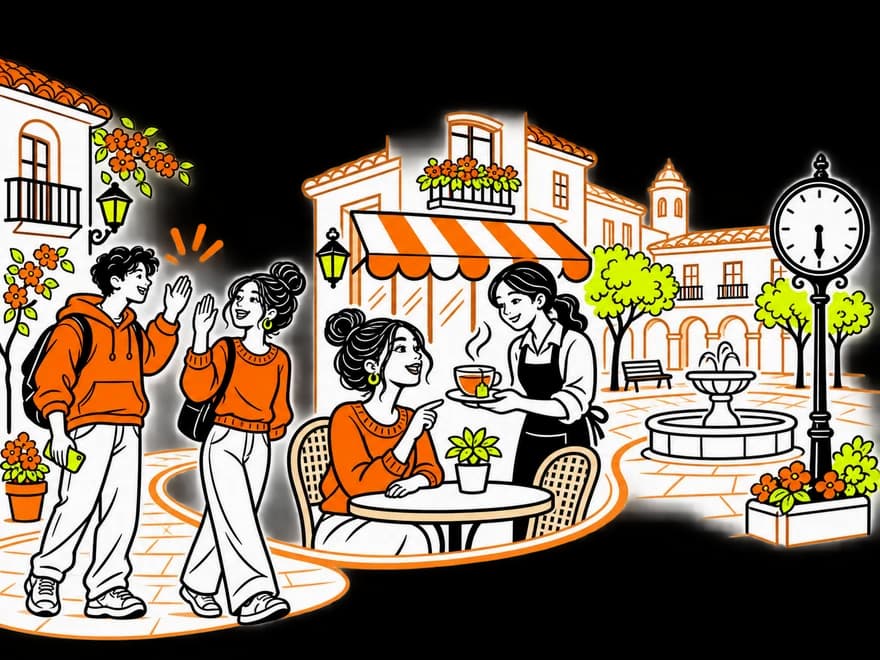
Start with a conversation you want to continue
Hola, soy Ana. ¿De dónde eres? - “Hi, I'm Ana. Where are you from?”
Soy de Sevilla. ¿Y tú? - “I'm from Seville. And you?”
This exchange includes an introduction, an answer and a question in return. You learn complete phrases and lines, understand their meaning and say both parts. Then you can connect the familiar structure to your own life: name your city, introduce a friend or talk about yourself.
The first topics in the Spanish programme relate to everyday tasks: introductions, home, the city, daily routines, food and meeting people. Learning goals draw on CEFR level descriptions and the Plan curricular del Instituto Cervantes. We adapt the sequence to short tasks and repeated practice in dialogues.
Explore a rule, then return to it in conversation
On a dedicated day, you study grammar and record a video with your own examples. The following days feature short dialogues with the same grammar focus.
For example, you first learn to say where someone is from: Soy de Sevilla. You then encounter the familiar structure in another conversation. When studying location, you use Estoy en casa - “I'm at home.” Each expression has a clear situation in which to use it.
After a series of dialogues, the programme moves to the next structure. This sequence gives daily practice a clear order: explanation, several returns to what you have learned, then a new topic.
How to complete a dialogue task
- Read the conversation and translation, and understand each line. Listen to the audio if your group has it enabled.
- Learn both parts and record them in one video. If the task asks for your own line, add it to the same video.
- Send your video to the group. Encourage other participants with a message or reaction.
You don't need a perfect take. What matters is completing today's step and continuing with your group. Everyone records at a convenient time, and the shared chat keeps participants' responses together.

Choose your first situation
- Three dialogues in Spanish - introductions, ordering at a café and meeting a friend, with translations and explanations of useful phrases.
- Ser or estar: what's the difference? - occupation, state, readiness and the location of an event. Three tasks with explanations.
- Hay or estar: what is there and where is it? - find a café, check its location and ask about tables.
Choose one article and say the whole dialogue. The next step is another short practice task in your group's programme.
Fit practice into your day
Start with the ready-made settings and confirm the start. But you can also choose the level, modules, conversation topics, posting time and rest days for each group. Explanations and instructions are available in 30 group languages.
A teacher can align the order of modules with their lessons and edit an individual task. Friends or a family can choose a convenient time and follow the ready-made programme. Manage all groups from one Control panel.
For teachers
Bring practice of a topic to Telegram: grammar and dialogues reach the group automatically, and students send videos of their completed tasks. Their responses provide material for the next lesson: discuss an expression, change the circumstances and continue the conversation in their own words.
IDVI handles scheduled posting. You choose the programme, follow your group's responses and help students move forward. The tool is free for every participant.
How the IDVI methodology works and which curricula we draw on

Who are you?
IDVI · Published: · Updated:
Reviewed by Roman Demyrov ·